
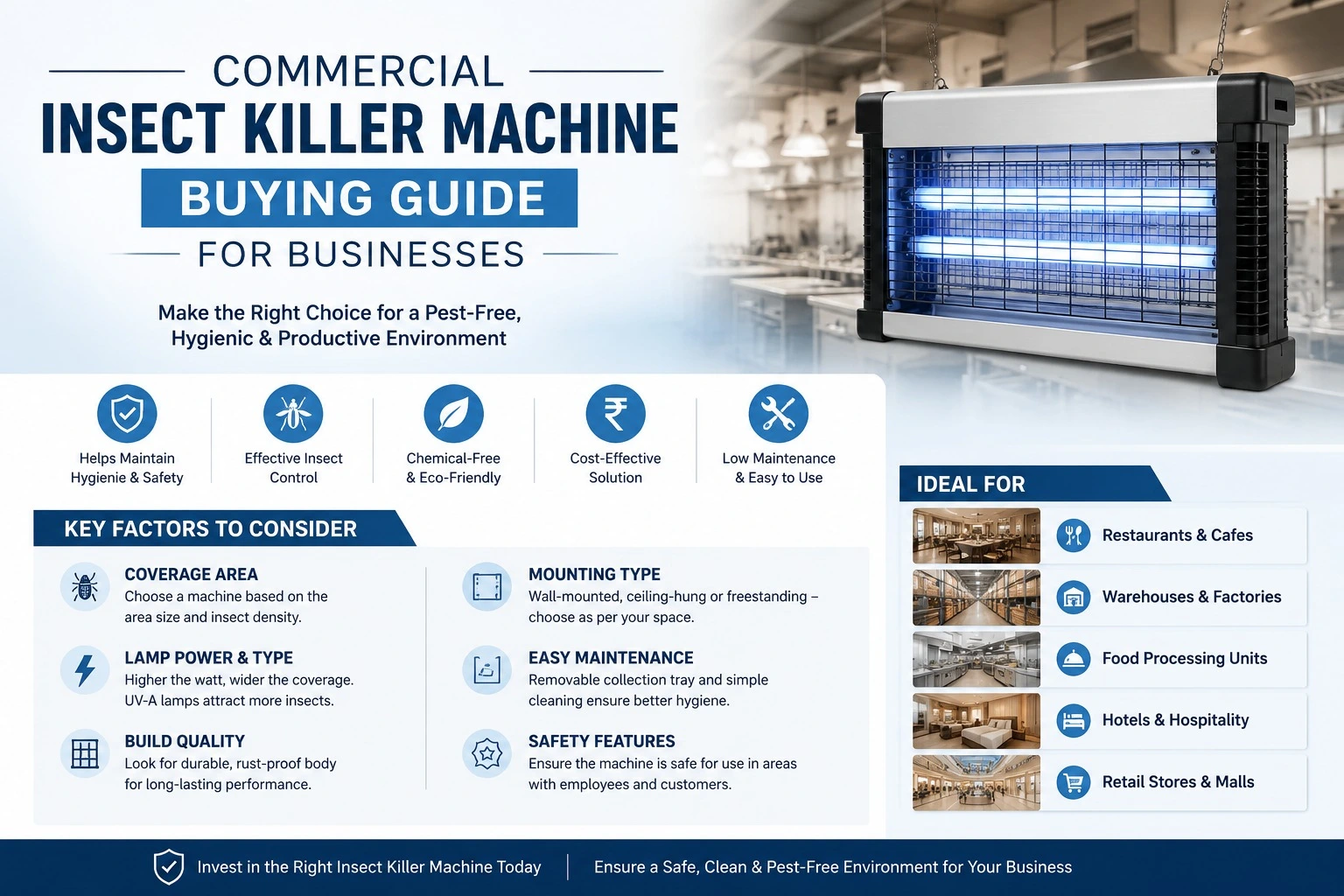
Why Businesses Are Switching to UV Insect Killer Machines.
Traditional pest control chemicals and sprays come with real downsides for commercial spaces — food safety concerns, occupational exposure, lingering odors, and the need to clear an area before and after use. UV insect killer machines solve this differently: they use UV-A light tubes to attract flies, mosquitoes, and other flying insects toward an electrified grid or sticky surface, eliminating them instantly and without residue.
Key advantages for businesses:
- Chemical-free and odorless — safe for kitchens, dining areas, patient rooms, and food handling zones
- Continuous, runs 24/7 in the background without disrupting staff or customers
- Low running cost — most models draw between 20W and 100W, comparable to a couple of light bulbs
- Supports compliance — helps meet FSSAI, hospitality, and healthcare hygiene standards
- Low maintenance — a removable collection tray is usually all that needs regular cleaning
What to Consider Before You Buy.
-
Coverage Area vs. Your Floor Plan
Every insect killer is rated for a specific square footage. Undersizing a unit means insects escape its attraction radius; oversizing wastes money. Measure your actual space — including ceiling height and airflow from AC vents or open doors, which can pull insects away from a poorly placed unit.
- Tube Wattage and Number of Tubes
Higher-wattage UV tubes throw a stronger attraction field over a larger area. Most commercial units use two tubes, ranging from 6W each in compact models to 40W each in heavy-duty industrial units.
- Build Material
Entry-level models typically use ABS plastic bodies, suitable for lighter indoor use. Mid-to-large commercial and industrial models use powder-coated MS (mild steel) bodies, which resist corrosion, dust, and wear far better in busy kitchens, warehouses, and humid environments.
- Mounting and Placement
Most commercial units are designed for wall mounting or tabletop placement. Position units away from direct competing light sources (which reduce UV attraction efficiency), away from food prep surfaces, and at a height that keeps the electrified grid out of casual reach.
- Power Consumption and Running Cost
Since these machines typically run around the clock, wattage adds up. Fortunately, even the largest industrial models in this category draw well under 150W, making 24/7 operation inexpensive.
- Warranty and After-Sales Support
Look for coverage on the two components most likely to need service: the electronic ballast (choke) and the PCB (circuit board). A manufacturer offering nationwide support and spare parts availability matters more than the sticker price once the unit is in daily commercial use.
Ascone C-Series Flying Insect Killer Machines — Model-by-Model Comparison.
Ascone's C-Series covers everything from small retail counters to 1,000 sq. ft. industrial floors. Here's how the seven models stack up:
|
Model |
Coverage Area |
Tubes |
Power |
Body Material |
Best Suited For |
|
C-100 |
150–200 sq. ft. |
2× 8W UV |
30W |
ABS |
Small shops, billing counters, boutique offices |
|
C-250 |
100–150 sq. ft. |
2× 6W UV |
20W |
ABS |
Compact kitchens, cafés, small clinics |
|
C-300 |
200–300 sq. ft. |
2× 8W UV |
30W |
Powder-coated MS |
Mid-size restaurants, offices, hospital wards |
|
C-900 |
300–400 sq. ft. |
2× 15W UV |
40W |
Powder-coated MS |
Full-service restaurants, hotel lobbies, kitchens |
|
C-1100 |
400–500 sq. ft. |
2× 18W UV |
60W |
Powder-coated MS |
Banquet halls, larger hospitality and healthcare spaces |
|
C-1500 |
400–500 sq. ft. |
2× 18W UV |
60W |
Powder-coated MS |
Food processing units, hotels, factories needing rugged build |
|
C-4000 |
800–1,000 sq. ft. |
2× 40W UV |
100W |
Powder-coated MS |
Warehouses, large industrial kitchens, cold storage, factories |
C-100 Flying Insect Killer.
The C-100 is Ascone's compact entry point, built for spaces up to 200 sq. ft. Its ABS body and twin 8W UV tubes make it a practical fit for small restaurants, offices, and retail counters that need reliable insect control without the footprint or cost of a larger commercial unit.
C-250 Flying Insect Killer.
Slightly more compact than the C-100, the C-250 is designed for tighter spaces up to 150 sq. ft. — think small kitchens, cafés, and clinics — while still running on efficient twin 6W UV tubes at just 20W of power draw.
C-300 Flying Insect Killer.
Stepping up to a powder-coated metal body, the C-300 covers 200–300 sq. ft. and is built to handle the daily wear of busy commercial kitchens and hospital environments where a plastic housing wouldn't hold up as well.
C-900 Flying Insect Killer.
The C-900 moves into serious commercial territory with 15W tubes and coverage up to 400 sq. ft. It's a strong match for full-service restaurants, hotel lobbies, and commercial kitchens that need stronger UV attraction across a larger open area.
C-1100 Flying Insect Killer.
Built for 400–500 sq. ft. spaces, the C-1100 pairs twin 18W tubes with a durable MS powder-coated body. It's well suited to banquet halls, larger hospitality venues, and healthcare facilities that need dependable, round-the-clock protection.
C-1500 Flying Insect Killer.
Sharing the same coverage and tube specification as the C-1100 but with a taller, heavier-duty housing, the C-1500 is positioned for food processing units, factories, and hotel back-of-house areas where ruggedness matters as much as performance.
C-4000 Flying Insect Killer.
The flagship of the range, the C-4000 is built for large-scale industrial use — warehouses, big-box kitchens, and processing floors up to 1,000 sq. ft. Twin 40W UV tubes deliver a much wider attraction field, backed by a heavy-duty powder-coated body for continuous, high-demand operation.
How to Pick the Right Model for Your Business.
-
Under 200 sq. ft. (small shops, offices, boutique cafés): C-100 or C-250
- 200–400 sq. ft. (restaurants, hospital wards, mid-size offices): C-300 or C-900
- 400–500 sq. ft. (banquet halls, hotels, food units needing rugged build): C-1100 or C-1500
- 800–1,000 sq. ft. (warehouses, industrial kitchens, factories): C-4000
If your space is split across multiple zones — say, a dining area plus a back kitchen — it's usually more effective to install two appropriately-sized units rather than one oversized machine trying to cover both.
Final Thoughts
A flying insect killer machine is one of the simplest hygiene upgrades a business can make: no chemicals, no odor, no disruption to staff or customers, and a running cost lower than a desk lamp. The key is matching the model to your actual floor area, build requirements, and duty cycle rather than guessing.
Ascone's C-Series gives businesses that flexibility — from the compact C-100 for a small counter to the C-4000 for a full industrial floor — all backed by warranty coverage on the ballast and circuit board. Get in touch with Ascone to discuss which model fits your space, or reach out directly on WhatsApp for quick guidance.